


Introduction
In life science R&D, there is a growing need for real-time data integration with LIMS/ELN solutions. Increasingly, scientists expect real-time integration with multiple data sources such as (but not limited to) instrumentation, raw data, environmental monitoring systems, manufacturing execution systems (MES) process analytical technologies (PAT), and various data pipelines.
Sapio’s Lab Informatics platform supports webhooks, a powerful option for real-time data integration and extending the platform capabilities. Webhooks are a way for one application to provide real-time information to another application about events that occur. The webhook sends an automated message from an application when a specific event happens, delivering real-time information to a designated URL. This allows different applications to communicate and react to events without the need for constant polling.
Webhooks vs. Standalone Webservice Calls
Webhooks are a powerful method to extend the Sapio platform’s functionality beyond its standard, out-of-the-box (OOTB) configuration. Unlike web service calls, which require an external system to constantly check for updates, a webhook sends an automated message when a specific event happens, delivering real-time information to a designated URL.
This “push” model of communication is more efficient and eliminates the need for constant polling. In the Sapio platform, webhooks are custom code, typically written in Python, that use the Sapio REST API to interact with the platform and execute custom logic. They are an event-driven mechanism initiated from within the Sapio platform. For example, when a user clicks a button, a scheduled action runs, or a data record changes, the system automatically sends a “bundle of context data” to an externally hosted webhook server.
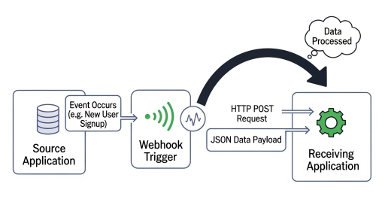
Figure 1. Concept of using Webhook for data integration.
Key Capabilities and Use Cases
Webhooks can be used when OOTB configurations and rules cannot meet critical customer needs. Here are some examples of what you can do with webhooks in the Sapio platform:
- Query and Manipulate Records: You can use a webhook to query for records that match an input value and then manipulate the data. This is more efficient than a user manually searching and making changes.
- Create Custom Tables: Webhooks can create “temporary Data Type” tables with information pulled from various parts of the system, a capability beyond the standard tables.
- Integrate with External Systems: Webhooks are highly customizable to meet the specific communication and authentication needs of third-party applications, making it easy to transmit data from Sapio to other systems.
- Automate Tasks: Webhooks can be configured to run on a schedule, automating routine tasks and processes.
Webhook Invocation Points
Admins can easily add webhooks through the Manage Rules and Webhooks tool in App Setup. A key part of defining a webhook is selecting its Invocation Type, which determines where in the Sapio system the webhook can be triggered.
Some common invocation points include:
- Main Toolbar: Puts a button on the main menu to call a webhook.
- Data Type Table Toolbar: Adds a button to a data table within a Data Type’s Individual Data View (IDV).
- Rules Engine: Webhooks can be called as part of a general rule or an Experiment Template rule.
- Scheduled Webhooks: Allows you to schedule a webhook to run at a specific time.
- Data Type Record Action Button: Creates a customizable button field on forms and tables that triggers a webhook when clicked.
- Selection List: A webhook can populate a selection list field with options when a user clicks on it.
- ELN Entry Submit: A webhook can be invoked when an ELN entry is submitted.
The variety of invocation points that are supported enables flexibility to optimize the user experience and workflow.
Building a Sample Webhook
Creating a webhook in the Sapio platform involves setting up a local server and then configuring the webhook within the Sapio application. While this blog provides a high-level overview, the practical, hands-on process of building and deploying a webhook is a core part of the Sapio Certified Engineering course. This comprehensive training provides the necessary example files, step-by-step guidance, and expert instruction to master these powerful customizations. Several Kalleid team members have attended the course and found it to be an effective, comprehensive, and great hands-on experience that prepares you well for client implementations.
Sapio’s Partnership with Kalleid
Kalleid is a member of the Sapio Sciences Partner Program. As a consulting partner, Kalleid leverages the Sapio Platform to deliver comprehensive, end-to-end digital solutions to their clients.
About Kalleid
Kalleid, Inc. is a boutique laboratory IT consulting firm that has proudly served the scientific community since 2014. We work across the value chain in R&D, clinical and quality areas to deliver support services for software implementations in highly complex, multi-site organizations.
We pride ourselves in supporting the success of your IT projects and overall organizational transformation efforts with a wide range of interconnected services. At Kalleid, we understand that people are at the center of any successful business transformation effort. Implementing effective change management strategies and strategic communications for scientific applications is the core of our integrated approach to IT projects. Our human-centered approach to software implementation also extends to supporting our clients with technical writing and documentation, business analysis/re-engineering, training/eLearning, software testing/validation and project management (both scrum/agile approaches).
To learn more, visit us at www.kalleid.com.
About Sapio Sciences
At Sapio Sciences, our mission is to improve lives by accelerating the entire drug lifecycle. Our cloud-based solutions – LIMS, ELN, and Scientific Data Cloud – are unified on a flexible, configurable, and AI-powered informatics platform, streamlining complex workflows, unifying scientific data, and enabling faster, smarter decisions across biopharma research and development, clinical diagnostics, and manufacturing.
Trusted by global leaders and innovators worldwide, we support a wide range of best-in-class applications, from NGS and bioanalysis to bioprocessing, stability studies, histopathology, antibody discovery, and in vivo studies.
Discover how Sapio Sciences can revolutionize your lab operations www.sapiosciences.com and follow us on LinkedIn.
